News Focus – Indonesian conservation institutions call on gov't to involve them in making regulations

30 January 2026
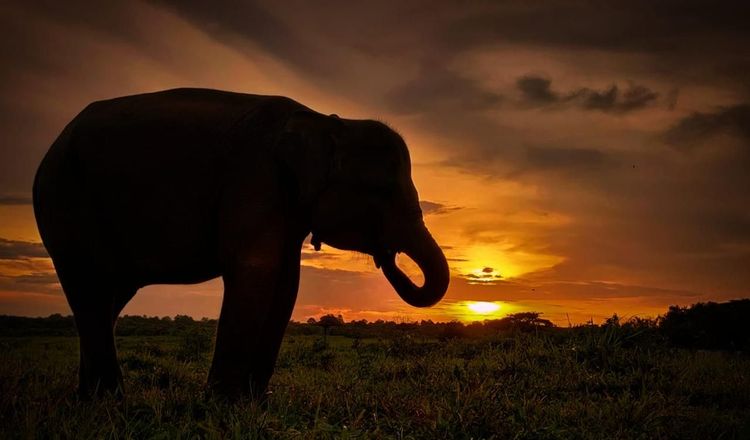
This undated photo shows a silhouette of an elephant in Indonesia's Way Kambas National Park, Lampung province. (The Indonesian Ministry of Forestry)
Jakarta (Indonesia Window) – Managers of Indonesian conservation institutions, such as national parks, zoos and safari parks, are calling on the government to involve them in making regulations that would impact managers in their implementation.
The managers made the call in an online discussion organized by the Indonesian Wildlife Conservation Forum (locally known as its abbreviation FOKSI) entitled 'Discussing the Elephant Riding Ban Policy', Thursday (Jan. 29).
The discussion presented Landscape Manager of Way Kambas National Park (locally known as its abbreviation TNWK) Sugiyo and Secretary General of the Indonesian Zoo Association (PKBSI) Tony Sumampau, who also serves as a Commissioner of Taman Safari Indonesia.
In the discussion, the speakers highlighted the issuance of the Ministry of Forestry Circular Letter Number 6 of 2025 concerning the Termination of Elephant Riding Demonstrations in Conservation Institutions, while emphasizing the importance of involving animal managers in the policy formulation process.
Tony emphasized that PKBSI and managers of conservation institutions in principle have never opposed government policies, including the circular.
“Even though in practice there are many challenges, we have never rejected the government regulation. But in the future, we hope to be invited to sit down together before a decision is made," Tony said.
According to Tony, PKBSI is a government partner in animal management in Indonesia, which has often been asked for assistance in various situations, from animals escaping from conservation institutions to conflicts between wildlife and humans, such as those between tigers or leopards and people.
“Therefore, we also want to be invited to talk. In the near future, we will convey this officially to the government," he said.
Tony also said that the Taman Safari Indonesia (TSI) Group had stopped elephant riding activities for visitors two years ago.
He admitted that he did not agree with the practice of riding elephants using chairs placed on saddles.
“If you sit directly on the saddle without additional chairs, like the mahouts do, I think it's still okay," he said.
In elephant management, the TSI Group applies the Asian Captive Elephant Standards (ACES), an independent, science-based certification system to ensure ethical and high-standard elephant care under human supervision.
Tony said the ACES standards have very strict criteria, even higher than those set by the government.
“If this is followed, the elephants will definitely prosper," he said, adding that good management has been proven to support successful elephant reproduction.
Since 2001, 33 Sumatran elephant births have been recorded within the TSI Group, a number he called the largest, even globally.
"We are ready to release them back into the wild, if the habitat is good and supports the elephants' lives," Tony said.
Based on the management's observations, Tony noted that elephants that are regularly walked and ridden actually have better body scores.
In the wild, elephants are used to walking kilometers every day, so walking is a natural need and a form of physical exercise for elephants, he said, while reminding that other points in the Circular Letter need to be considered, especially regarding the use of elephants for disaster relief.
He mentioned the experience when elephants were used to clear logs left over from the major floods in Aceh.
“I'm worried that elephants would step on nails or sharp objects that could injure their feet, which can cause infections and even tetanus," he said.
According to him, elephants' natural behavior is not to carry wood. Tony emphasized that elephants' feet are very susceptible to injury, especially if they are submerged in water for a long time. "
“Have you ever thought about who will care for the elephants later?" he said, while giving an example of the experience when elephant troops were deployed to clear illegal buildings and land boundary fences in forest areas.
As a result, several elephants were attacked by tetanus due to being pricked by nails, with a long treatment process and expensive medical costs.
Apart from the Ministry of Forestry, Tony said that his party also received an appeal from the Ministry of Tourism regarding the implementation of tourism that prioritizes elephant protection.
The appeal included asking managers of national parks, conservation areas, conservation parks, and forestry businesses to adjust interaction activities with elephants, such as bathing and riding elephants.
Tony explained that in their natural habitat, elephants do enjoy bathing activities. In conservation institutions, mahouts or keepers help brush the elephants' bodies because there are not always large rocks or tree trunks for elephants to rub their bodies on.
"Once again, we follow all government rules and appeals. However, we really hope that we can be invited to sit down together before the rules or appeals are issued," Tony emphasized.
He pointed out that zoos and safari parks are conservation institutions that support Indonesian tourism and therefore, according to him, the involvement of managers in policy formulation is important to avoid confusion.
From attractions to educational tourism
Meanwhile, Landscape Manager of Way Kambas National Park (known as its abbreviation TNWK), Sugiyo, stated that he supports the issuance of Circular Letter No. 6 of 2025 from the Ministry of Forestry concerning the suspension of elephant riding performances.
However, he emphasized that efforts to treat elephants more humanely are not free from various challenges in the field.
"Elephants are also creatures of the earth. Their welfare must be prioritized. We can benefit each other, but not harm each other," Sugiyo said.
According to him, elephants, whose populations in Sumatra and Kalimantan have continued to decline significantly since 2017, are now increasingly isolated in their own habitat.
This decline is caused by various factors, ranging from habitat destruction, poaching, to conflict with humans.
As of 2021, data processed by the Ministry of Forestry and AURIGA Nusantara (a non-governmental organization focused on the preservation of natural resources and the environment in Indonesia) showed that there were 151 concession-holding companies in Sumatra whose activities overlapped with wildlife habitat, including elephants.
Sugiyo expounded that the government has actually been running various programs for a long time to conserve elephants and minimize conflicts with humans.
One of the programs was Operation Ganesha in 1982–1984, which herded or relocated elephants on a large scale from Air Sugihan to Way Kambas National Park.
During that period, the concepts of Tata Liman, Bina Liman, and Guna Liman were implemented, where elephants were trained and utilized in land management activities.
Currently, elephant management is carried out through the Elephant Training Center (PLG), one of which is in TNWK (Way Kambas National Park).
Tata Liman is an Indonesian government program that began around the 1980s to reorganize the habitat of Sumatran elephants.
Bina Liman is a program for the development and training of Sumatran elephants, particularly in the context of conservation and taming.
Guna Liman is an approach to utilizing trained Sumatran elephants wisely, safely, and with attention to animal welfare to assist human work, such as clearing post-flood debris in areas that are difficult to reach by heavy equipment.
PLG Way Kambas previously had an elephant riding attraction as a tourist attraction, before it was eliminated and replaced with an educational tourism concept, which invites visitors to see elephants in their natural environment without riding demonstrations.
According to Sugiyo, a number of challenges faced by TNWK since the issuance of the Circular Letter prohibiting elephant riding, one of which is the loss of a source of income, so that a new, more creative and sustainable business model is needed.
In addition, managers need to change the pattern of elephant care from work activities to more natural activities so that the elephants do not experience boredom or stress. For this reason, behavioral enrichment must also be created so that the elephants remain active and healthy both physically and mentally.
Other challenges include retraining the mahouts (elephant keepers) so that the care of the mammals is carried out without violence, providing a wider area for elephants to move, forage, and engage in social activities, and ensuring that the elephants remain obedient and non-aggressive even though they are no longer undergoing intensive training for shows.
This is important to ensure the safety of staff and visitors, Sugiyo said, while revealing that TNWK had never been invited to sit down or asked for input before the circular letter was issued, even though the policy had an impact directly impacting elephant management on the ground.
He believes that early involvement of managers is crucial to ensure that the resulting policies are not only conceptually ideal, but also realistic and can be effectively implemented in the field.
Reporting by Indonesia Window
Bagikan

Komentar
Berita Terkait
COVID-19 – Indonesian migrant workers undergo strict quarantine upon arrival in Taiwan
Indonesia
•
20 Dec 2020
43rd ASEAN Summit to serve journalists with 24-hour media center
Indonesia
•
29 Aug 2023

Feature - Indonesia wins the New Destination Champion Award 2026 by La Liste
Indonesia
•
26 Nov 2025
Former Indonesian ambassador to UAE gives books to @M Institute library
Indonesia
•
18 Jan 2024


Berita Terbaru

Minister: Airports affected by Mount Anak Krakatau volcanic ash reopen
Indonesia
•
08 Sep 2026
TETO: Sudut Pandang is one of important mass media in Indonesia
Indonesia
•
06 Sep 2026
Feature – Preserving 180-year-old legacy: UIN Ar-Raniry digitizes Quranic manuscript of Acehnese scholar
Indonesia
•
29 Aug 2026
Opinion – Prophet Muhammad ﷺ and journey toward literacy, ecological awareness
Indonesia
•
27 Aug 2026